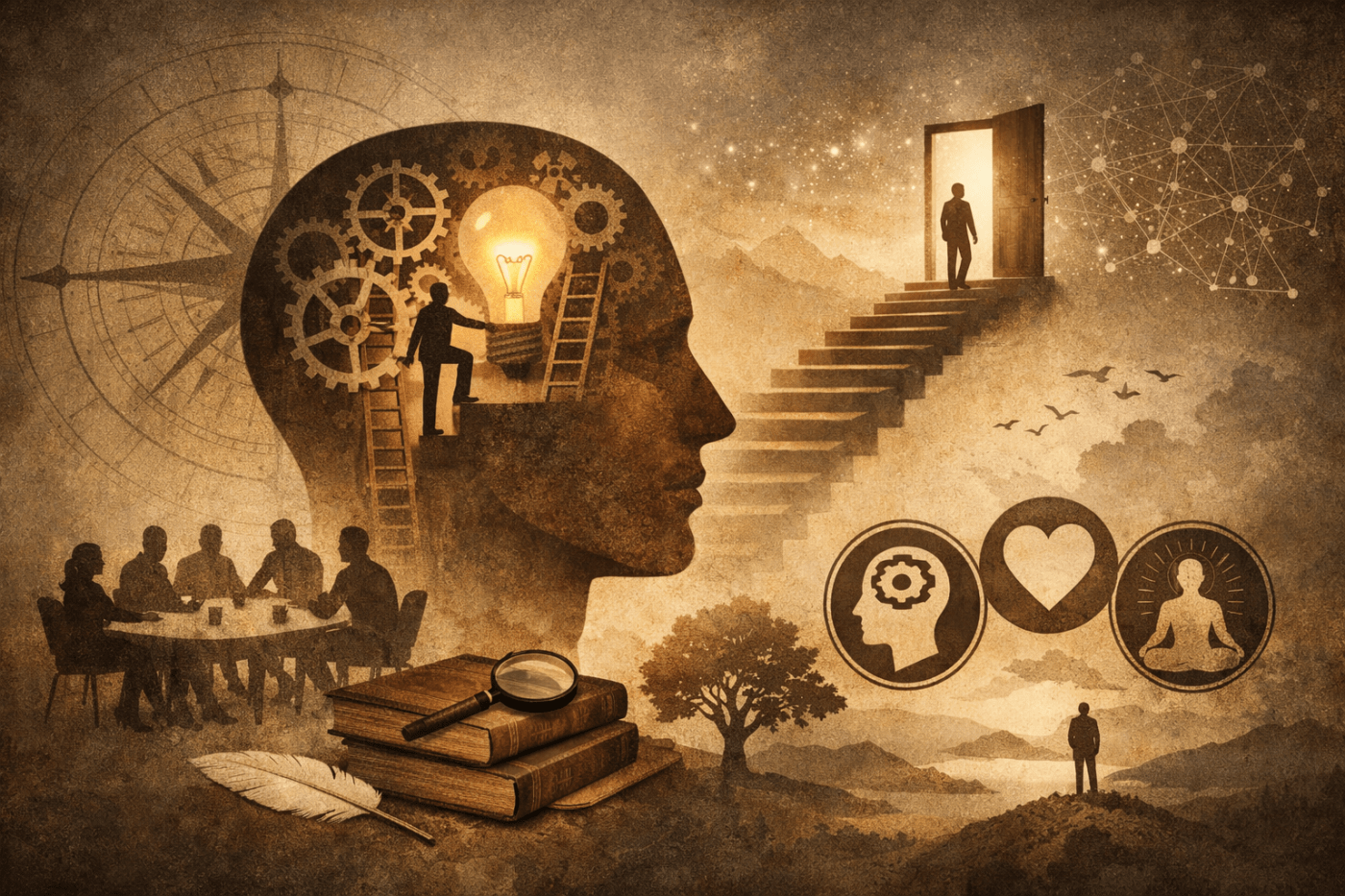
Metacognition is thinking about thinking.
It sounds simple, almost academic. But it may be the most practical skill I have ever developed.
Over time I have come to realize that if you want to change your life, your outcomes, or achieve something you have never had, there is one thing that must change first. Your thinking.
We often focus on changing circumstances, relationships, habits, or environments. But the root of lasting change begins in the mind. If the thinking stays the same, the results usually stay the same.
One of the most powerful ways to shift thinking is to expose it to other perspectives.
Conversation is one of my favorite tools for this. Not just conversations with experts or intellectual giants, but with everyday people. Even those you may not immediately consider highly accomplished can offer a perspective you do not see. When you allow other viewpoints into your mental framework, you gain angles you never considered.
Think of a think tank. Twenty people. Forty eyes. One subject. Suddenly there are twenty-one minds exploring one idea. Forty-two perspectives examining the same problem. Why to do it. Why not to do it. How to do it. When to do it. The power is not in one brilliant mind. It is in multiplied perception.
Another method is reading. When you want to succeed in a specific area, find those who already have. Success leaves clues. A book may take you one or two weeks to read, yet it may contain lessons that took the author fifty or sixty years to learn. You absorb decades of experience in days. Even if you extract one transformative insight from a book and apply it, the investment was worth it.
But gathering new information is only the beginning.
For years, almost unknowingly, I practiced something deeper. Later I learned the word for it. Metacognition. Thinking about thinking.
If changing your thinking changes your outcomes, then you must examine not only what you think, but how you think.
You can feed your mind new data through conversation and reading. But if you process that data through the same old mental filters, you will still arrive at the same conclusions.
So the real work begins here.
Why do I think this way? What assumptions am I using? What filters am I applying? What objective am I pursuing? What strategy governs my decisions? What is my mission? My vision?
Philosophy helped me tremendously in this area. It forced me to analyze the structure of my thoughts. Not just the content, but the architecture.
When someone starts a business, they begin with structure. Vision. Mission. Objectives. Strategies. Principles. Systems. Everything that flows through that business is filtered through those structures.
Yet we rarely apply that same intentionality to ourselves.
You are the CEO of your own mind. The steward of your own soul. The manager of your own emotional and spiritual processes. And yet most of us operate without a clearly defined framework for how we think.
We understand intellectual intelligence. It is about data, knowledge, problem solving. The more information we gather, the sharper we can become.
In recent decades we have learned more about emotional intelligence. If we want strong relationships, healthy marriages, effective leadership, we must understand emotions. Ours and others.
But there is another dimension that is not discussed as often. Spiritual intelligence.
Spiritual intelligence gives structure to the inner drive. It asks deeper questions about purpose, meaning, and direction. Just as we give the body structure through nutrition, exercise, and discipline, we must also give structure to the soul. It needs vision. It needs principles. It needs intention.
If the body is fed but the soul is neglected, we are incomplete. If the mind is sharp but the spirit is aimless, we are fragmented.
True transformation requires alignment. Physical effectiveness. Emotional effectiveness. Spiritual effectiveness. Integrated into one whole.
There is an old quote that says if you want something you never had, you have to do something you never did.
It took me a long time to understand that the most important “something” I needed to change was not my location, my job, or even my habits.
It was my thinking.
When I began restructuring how I thought, how I filtered information, how I defined purpose and strategy, my life underwent a revolution. Not overnight. Not magically. But steadily and profoundly over the past twenty years.
Changing my thinking changed my trajectory.
And that is where true transformation begins.

 Jimmy Perez
Leave a comment