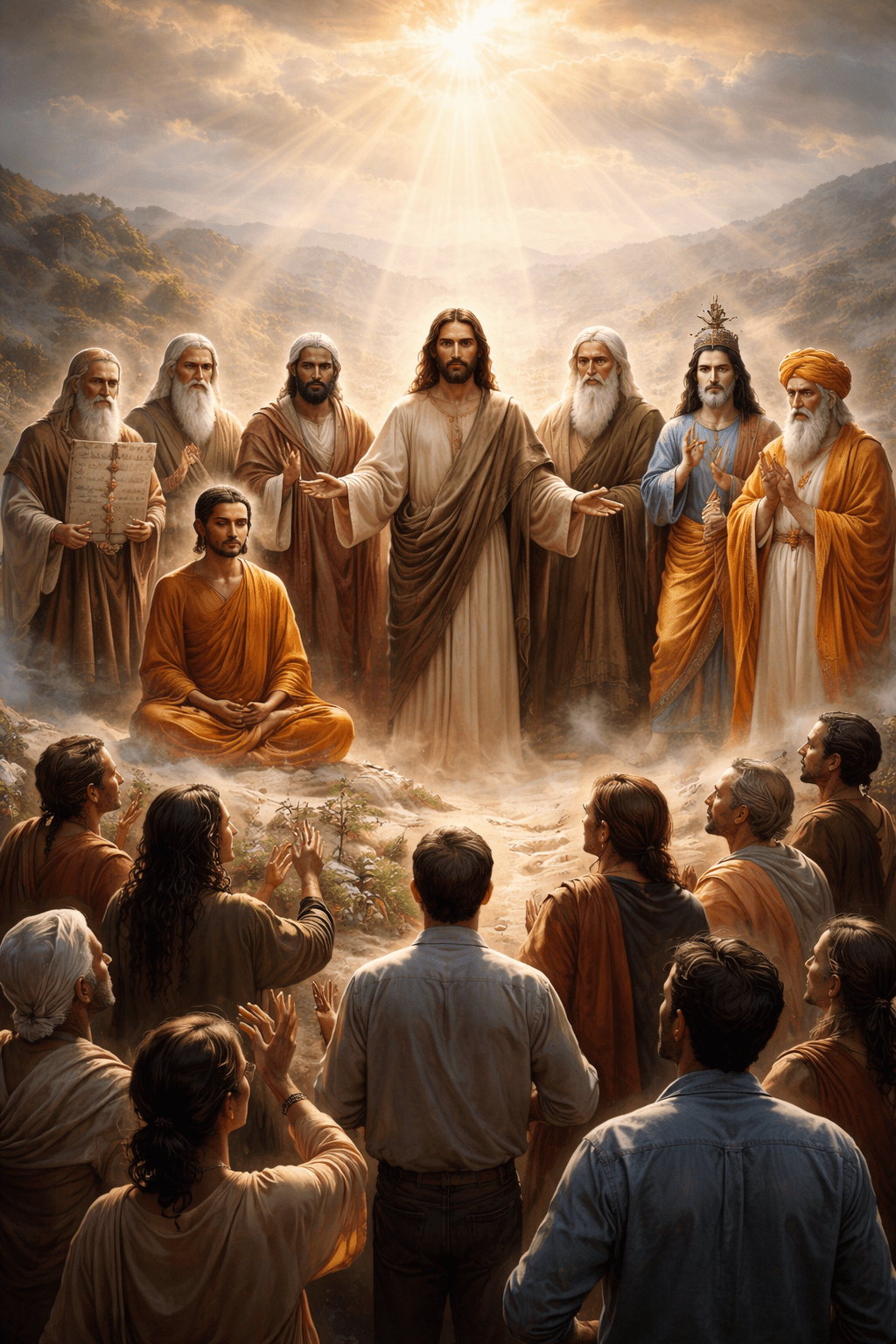
Many of us grow up choosing a side. A team. A creed, religion, nationality, or identity that becomes a box separating “us” from “them.” Sometimes we inherit it from family or culture. Sometimes we adopt it to belong. Either way, once inside that box, we often dismiss anything said by those outside it.
This is deeply saddening, and on many levels, profoundly limiting.
Not long ago I spoke to someone about a beautiful teacher who had transformed my understanding of life. As soon as this person learned that the teacher came from a different background, he found one belief he disagreed with and used it to discard everything else the teacher had to offer. One disagreement was enough to seal the box shut.
I could not help but think about myself. I have done things I regret. I have stolen. I have hurt people. I have dishonored those who loved me. I have spoken words against God. I have lied more times than I can count. Yet I believe that through growth, repentance, and grace, I have become a man capable of deep love, meaningful wisdom, and a character I strive to make worthy of imitation. If that man knew my past, he might place me in the same “evil” box and refuse to hear anything I say.
I understand this mindset because I once lived inside it. Like many people, I was raised to believe that those outside my group were not only wrong but dangerous, perhaps even aligned with evil. Thankfully, curiosity and honest questioning led me to study other philosophies, religions, and ways of life. What began as rebellion became education, and education became liberation.
Ironically, when the goal shifts from separation to understanding, the common ground becomes overwhelming.
After more than two decades of studying these traditions, I have found that most of them revolve around three fundamental dimensions of human existence:
Inner world — thoughts, identity, awareness
Outer world — actions and relationships
Transcendent world — meaning beyond the self
The Inner World
Across traditions, the inner life is the starting point. The problem is not merely outside us; it lives within us.
Common themes include:
Ego versus true nature
Illusion versus reality
Awakening or enlightenment
Purification of the heart and mind
Self-knowledge
Teachers as diverse as Jesus Christ, Gautama Buddha, Lao Tzu, and Krishna all pointed inward.
Jesus spoke of the Kingdom of God within.
Buddha taught that suffering arises from craving and ignorance.
Lao Tzu urged a return to the natural, unforced self aligned with the Tao.
Krishna taught that our true self is beyond body and mind.
Different traditions use different language. Being “born again.” Dying to the self. Awakening. Nirvana. Enlightenment. Yet they all point to an inner transformation, a shift in awareness.
As a Christian, I am especially moved by the idea that the Kingdom of Heaven is within us. My journey is one of peeling back layers of conditioning until I encounter the divine presence at the core of my being.
The Outer World
Inner transformation is not meant to remain private. It must express itself in how we live.
Common ethical teachings include:
Compassion and nonviolence
Humility
Detachment from greed and power
Service and love
Harmony with others
Again, the same teachers converge:
Jesus commanded love of neighbor, even enemies.
Buddha outlined the Eightfold Path of right action and livelihood.
Lao Tzu praised gentle leadership and non-force.
Krishna taught acting selflessly without attachment to results.
The message is unmistakable: spiritual insight must become ethical action. Right living is the visible fruit of inner awakening.
The Transcendent World
Beyond the inner self and social life lies a deeper reality, the ultimate source or ground of existence.
Traditions speak of it in many ways:
God
Tao
Dharma
Brahman
Nirvana
Ultimate Truth
Common themes include:
Union with the divine
Surrender rather than control
Trust in a higher order
Liberation from suffering
Peace beyond circumstances
Jesus spoke of a relationship with the Father and surrender to God’s will.
Buddha described liberation from the cycle of rebirth.
Lao Tzu emphasized alignment with the Tao.
Krishna taught devotion and union with the Divine.
For me, this is where the soul becomes central — the spark of God within. True freedom comes not from domination, but from surrender.
Why Separation Persists
If these truths are so universal, why do we remain divided?
Because the ego thrives on separation. It builds identities, hierarchies, and conflicts. Throughout history we see this pattern repeated across religions, politics, nations, ethnicities, languages, and even skin color.
Spirit seeks unity. Ego seeks division.
As a believer, I hold above all the command to love God and love my neighbor. This teaching dissolves boundaries rather than reinforcing them. To truly love God’s creation, we must dismantle the walls that keep us apart.
A Hope for Humanity
Perhaps this sounds naive. Perhaps idealistic. Yet I sense a shift underway: slow, uneven, but real. More people are beginning to look beyond inherited divisions and recognize our shared humanity.
I believe the day will come when identity rooted in separation gives way to identity rooted in unity, when we see ourselves first not as members of competing groups but simply as human beings.
If great teachers such as Moses, Muhammad, Confucius, Guru Nanak, Adi Shankaracharya, or Rumi appeared today, I suspect they would emphasize compassion, humility, and reverence for the divine above allegiance to any label.
Their message would likely be simple: love God, love one another, and care for the world.
Knowing Our Neighbor
The list of teachers who affirm these three dimensions is far longer than the few mentioned here. But the essential point remains: beneath the diversity of traditions lies a shared moral and spiritual architecture.
To love our neighbor, we must first recognize who our neighbor truly is.
The parable of the Good Samaritan illustrates this beautifully. Compassion transcends tribe, religion, and identity. The one who showed mercy was not the one who belonged to the “right” group, but the one who chose love over division.
In the end, the opposite of separation is not uniformity. It is compassion.
And compassion begins when we stop asking, “Which team are you on?” and start asking, “How can I help?”



Leave a Reply