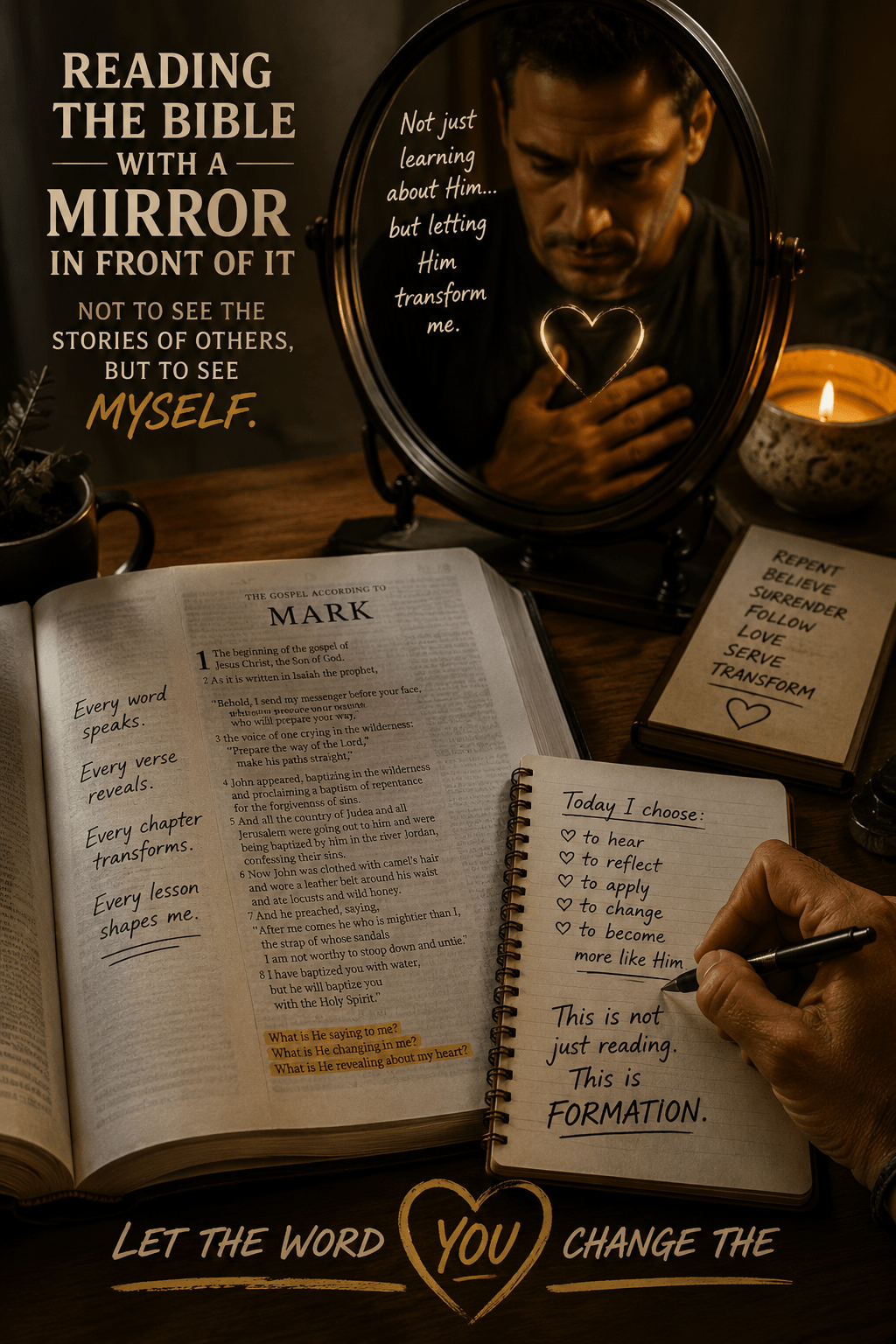
The Heart That Truly Belongs to God
Mark 12 continues Jesus’ final conversations in Jerusalem, but beneath every question and every answer lies one central invitation.
Jesus is no longer simply exposing the failures of the religious leaders. He is revealing the condition of every human heart.
Again and again, He uncovers the subtle ways we can appear devoted to God while still holding tightly to our own agendas, our need for control, our pride, and our desire for recognition.
Read with the mirror in front of you, and this chapter asks a deeply personal question:
Have I given God my whole heart, or only the parts I am comfortable surrendering?
The central message of Mark 12 is simple:
God is not looking for impressive religion. He is looking for transformed people whose lives are rooted in love.
Living as a Steward, Not an Owner
Jesus begins with the parable of the vineyard. A landowner entrusts his vineyard to tenants, but when the time comes to return what belongs to the owner, they refuse. Eventually, they even kill the owner’s beloved son.
At its heart, this story is about ownership.
The tenants slowly begin believing the vineyard belongs to them.
It is easy to see the same pattern within ourselves.
Life has a way of convincing us that everything we have belongs entirely to us.
Our time.
Our abilities.
Our relationships.
Our possessions.
Our influence.
Our opportunities.
Yet every one of these is a gift entrusted to our care.
Nothing we possess is truly ours forever.
Everything is stewardship.
The ego clings tightly and says,
“This is mine.”
The Spirit gently reminds us,
“This has been entrusted to you for a season.”
Transformation begins when we stop asking,
“What can I keep?”
and begin asking,
“How can I faithfully care for what God has placed in my hands?”
Ask yourself:
Am I living like an owner, or like a faithful steward?
Whose Image Do I Reflect?
The religious leaders try to trap Jesus by asking whether taxes should be paid to Caesar.
Jesus asks them to look at a coin.
It bears Caesar’s image.
Then He says,
“Give to Caesar what belongs to Caesar, and to God what belongs to God.”
His answer reaches far beyond politics.
The coin belongs to Caesar because it bears his image.
You belong to God because you bear His.
The question is no longer about money.
It becomes a question of identity.
If God’s image is stamped upon every human life, then every thought, every decision, every relationship, and every ordinary moment becomes an opportunity to reflect Him.
True worship is not confined to church services or religious activities.
It is revealed in the person we become.
Ask yourself:
Does my life reflect the One whose image I carry?
Leaving Room for Mystery
The Sadducees approach Jesus with a complicated question about the resurrection, convinced they have created a problem that cannot be answered.
Instead, Jesus reveals the limitation is not God’s power.
It is their imagination.
They had confined God to what made sense within their own understanding.
How often do we do the same?
Whenever life becomes confusing, we are tempted to believe that if we cannot understand something, God cannot possibly be working.
Faith invites us into something much larger.
It reminds us that God’s wisdom always extends beyond our perspective.
The more we grow spiritually, the more comfortable we become admitting that we do not have every answer.
Humility creates space for wonder.
Transformation often begins where certainty ends.
Ask yourself:
Have I placed limits on God because I cannot yet understand what He is doing?
The Foundation of Everything
A teacher of the law asks Jesus which commandment matters most.
Jesus answers with remarkable simplicity.
Love God with all your heart, soul, mind, and strength.
Love your neighbor as yourself.
Everything else rests upon these two commands.
Jesus reduces the entire spiritual journey to one word.
Love.
Not religious achievement.
Not theological knowledge.
Not public recognition.
Love.
When God’s love truly transforms us, it naturally begins flowing outward.
We become more patient.
More compassionate.
More forgiving.
More generous.
More willing to listen than to judge.
Love becomes less about emotion and more about the way we choose to live.
Spiritual maturity is measured not by how much Scripture we can quote, but by how much the character of Christ is becoming visible in us.
Ask yourself:
Is my relationship with God making me a more loving person?
When Knowledge Becomes Pride
Jesus then warns the people about the scribes.
They loved respect.
They loved recognition.
They loved titles and honor.
Yet somewhere along the way, they had begun loving the appearance of spirituality more than the transformation it was meant to produce.
This warning reaches beyond first-century religious leaders.
The ego can quietly attach itself to almost anything.
Even spiritual growth.
We can begin seeking knowledge simply to feel superior.
We can pursue truth for the sake of winning arguments instead of becoming more humble.
Knowledge is a beautiful gift.
But knowledge without love easily becomes pride.
The purpose of truth is never to inflate the ego.
It is to transform the heart.
Ask yourself:
Am I growing in humility as I grow in understanding?
The Offering That God Notices
The chapter closes with a quiet moment that many people would have overlooked.
Jesus watches people place their offerings into the temple treasury.
The wealthy contribute large amounts.
Then a poor widow approaches and offers two small coins.
To everyone else, her gift appears insignificant.
To Jesus, it is extraordinary.
Why?
Because she gave from trust.
She did not give what was convenient.
She gave what reflected her heart.
God has never measured generosity the way the world does.
The world measures the size of the gift.
God measures the depth of surrender.
This story reminds us that God is never impressed by appearances.
He is moved by wholehearted trust.
Whether we are giving our time, our attention, our resources, or our love, the question is never,
“How much did I give?”
The deeper question is,
“How much of my heart came with it?”
Ask yourself:
Am I giving God what is left over, or am I giving Him my first and my best?
The Mirror of Mark 12
Mark 12 gently invites us to examine our lives.
- Am I living as an owner or a steward?
- Does my life reflect the image of God?
- Have I placed limits on what God can do?
- Is love becoming the defining characteristic of my life?
- Is my knowledge producing humility or pride?
- Have I truly surrendered my heart, or only what feels comfortable?
These are not questions meant to condemn us.
They are invitations to become more fully alive.
The Heart of Mark 12
Throughout this chapter, we meet people who had almost everything.
The religious leaders possessed knowledge.
The wealthy possessed resources.
The crowds possessed admiration for Jesus.
Yet something essential was missing.
Only the widow understood what God desired most.
Not impressive gifts.
Not public recognition.
Not perfect performance.
A heart that trusted Him completely.
That same invitation remains today.
God is not asking for a carefully managed version of your life.
He is asking for your heart.
When we stop clinging to ownership, release our need for recognition, choose love over pride, and trust God with everything we have, something beautiful begins to happen.
Our lives slowly become the very thing Jesus came to restore.
Not people who simply know about God.
But people whose hearts truly belong to Him.



Leave a Reply