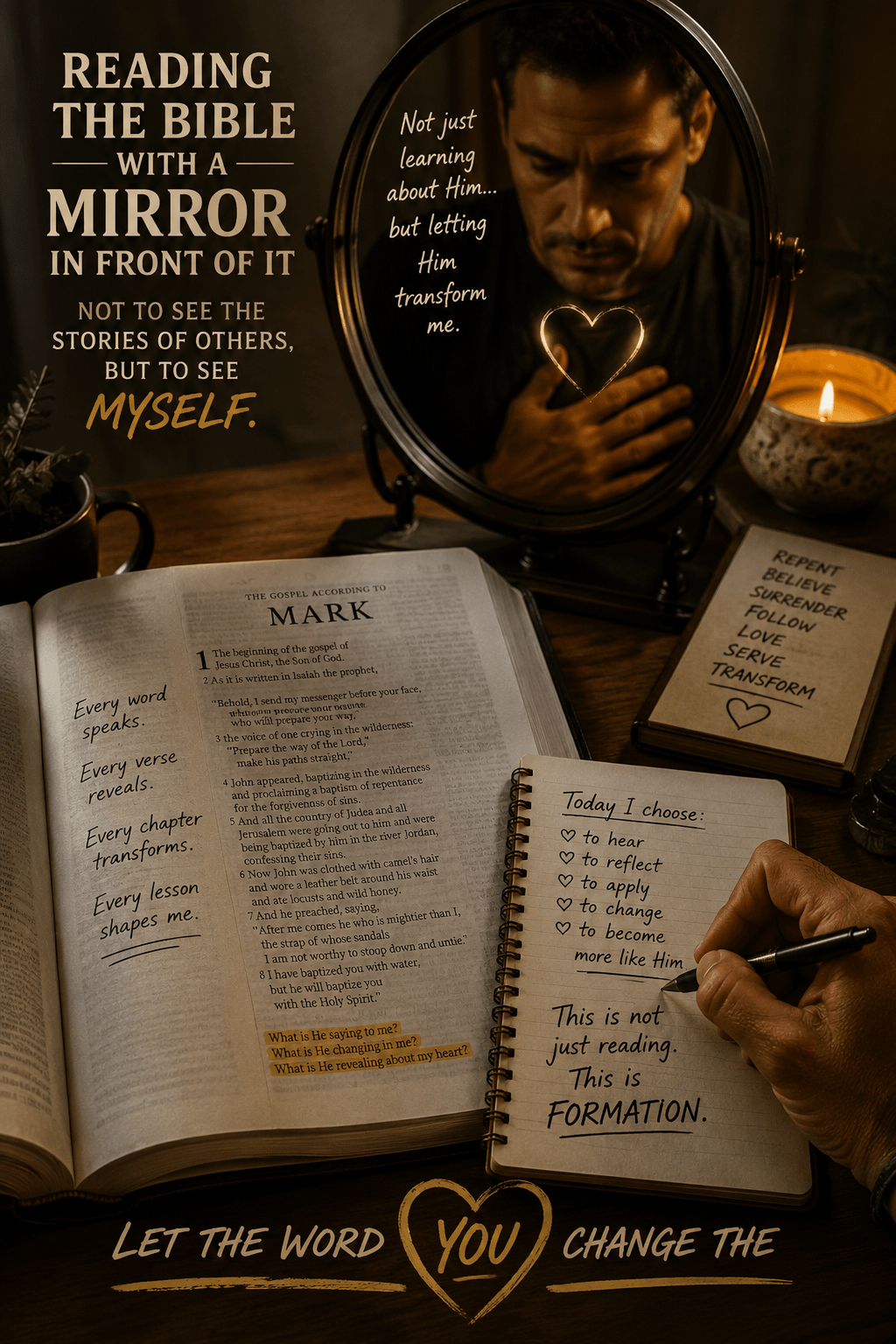
Mark 2 reveals a profound conflict that still lives inside every human heart: the conflict between outward performance and inward transformation. In every story of this chapter, Jesus confronts the tendency to focus on appearances while neglecting the deeper condition of the soul. He is not merely healing bodies, challenging traditions, or debating religious leaders. He is restoring humanity to the life it was created to live.
The central question of the chapter is this:
Will I cling to appearances, traditions, and performance, or will I allow God to change me from the inside out?
The Paralytic: Remove Whatever Keeps You From Jesus (Mark 2:1-12)
When four friends bring a paralyzed man to Jesus, they cannot get through the crowd. Rather than giving up, they climb onto the roof, tear it open, and lower him directly into the presence of Christ.
What Jesus says first surprises everyone:
“Son, your sins are forgiven.”
Before addressing the man’s physical condition, Jesus addresses the deeper paralysis of his heart. The greatest problem was never his inability to walk. It was his separation from the life God intended for him.
The Inner Lesson
Every one of us carries forms of paralysis that cannot be seen with the eyes.
Fear.
Shame.
Pride.
Addiction.
Bitterness.
Unforgiveness.
False beliefs.
These hidden conditions often cripple us far more than any physical limitation ever could.
The determination of the four friends teaches another powerful truth. Transformation rarely happens by accident. Sometimes we must tear through whatever stands between us and God. Comfort, excuses, distractions, pride, and the opinions of others can all become roofs that prevent us from experiencing His transforming presence.
The greatest miracle in this story is not that the man walked.
The greatest miracle is that his soul was made whole.
Reflection
What “roof” is keeping me from fully surrendering to God?
—
The Call of Levi: Grace Finds the Unlikely (Mark 2:13-17)
Jesus walks past the tax booth and calls Levi, a man despised by nearly everyone around him. Then He does something even more shocking. He sits down and shares a meal with sinners.
The religious leaders are scandalized.
Jesus simply replies:
“I did not come to call the righteous, but sinners.”
The Inner Lesson
The Kingdom of God is not built on perfection.
It is built on humility.
Those who believe they already have everything cannot receive anything. Those most aware of their brokenness are often the most open to transformation because they recognize their need for grace.
Levi leaves everything immediately.
He does not negotiate.
He does not hesitate.
He simply follows.
Every disciple eventually faces the same decision.
Leave the old identity behind.
Walk toward the new one.
Transformation always begins when we are willing to release who we have been so God can reveal who we were created to become.
Reflection
Am I protecting an identity I have outgrown?
—
Fasting: Transformation Is About Relationship, Not Ritual (Mark 2:18-22)
The Pharisees ask Jesus why His disciples do not fast like everyone else.
Jesus responds by comparing Himself to a bridegroom at a wedding. While the bridegroom is present, there is no reason to mourn.
He then offers two illustrations.
New cloth cannot patch an old garment.
New wine cannot be poured into old wineskins.
The Inner Lesson
God does not simply improve the old self.
He creates something entirely new.
Many people want Jesus to make their old identity slightly better.
Jesus wants to replace it.
Old beliefs.
Old fears.
Old identities.
Old habits.
Old ways of thinking.
None of these can contain the new life God desires to pour into us.
Transformation requires becoming a new vessel.
Growth is not about adding Jesus onto our existing life. It is about allowing Him to create a completely new life within us.
Reflection
What old way of thinking can no longer hold what God is teaching me?
—
Lord of the Sabbath: Rest Is Found in Christ (Mark 2:23-28)
As Jesus’ disciples walk through the grainfields on the Sabbath, they begin picking heads of grain to eat. Once again the Pharisees focus on rule-breaking instead of the heart behind the action.
Jesus answers:
“The Sabbath was made for man, not man for the Sabbath.”
The Inner Lesson
Religion often turns gifts into burdens.
God created the Sabbath as a blessing.
Legalism transforms it into another performance.
The deeper Sabbath is not simply one day each week.
It is an inner condition of the soul.
The soul finally rests when it stops trying to earn what God has already given freely.
Many of us still live like the Pharisees.
We strive.
It requires a completely new heart.
We prove ourselves.
We compare ourselves.
We perform.
Jesus offers another way.
Live from acceptance instead of striving for acceptance.
The Kingdom begins when the soul learns to rest in the love of God rather than constantly trying to deserve it.
Reflection
Am I serving rules, or am I allowing God to transform my heart?
—
The Thread That Connects Mark 2
Every encounter in this chapter contrasts two kinds of people.
Those who cling to the outside.
And those willing to be transformed on the inside.
One group values appearances.
The other values surrender.
One protects tradition.
The other embraces transformation.
One performs religion.
The other experiences relationship.
One seeks approval through effort.
The other receives grace through humility.
The Kingdom of God cannot simply be added onto our old life.
—
Chapter Summary
Mark 2 teaches that Jesus did not come merely to improve behavior. He came to transform identity.
He forgives the deepest paralysis of the soul, calls ordinary people into extraordinary purpose, replaces empty religious performance with living relationship, and invites us into true rest.
This chapter reminds us that Christianity is not about becoming a better version of our old self. It is about becoming a new creation. Jesus continually directs our attention away from outward appearances and toward the condition of the heart, because lasting transformation always begins within.
Every story asks the same question:
Will I protect the person I have been, or will I allow Christ to create the person I was made to become?
Key Reflection
The greatest miracle is not that our circumstances change. The greatest miracle is that we change.

 Jimmy Perez
Leave a comment