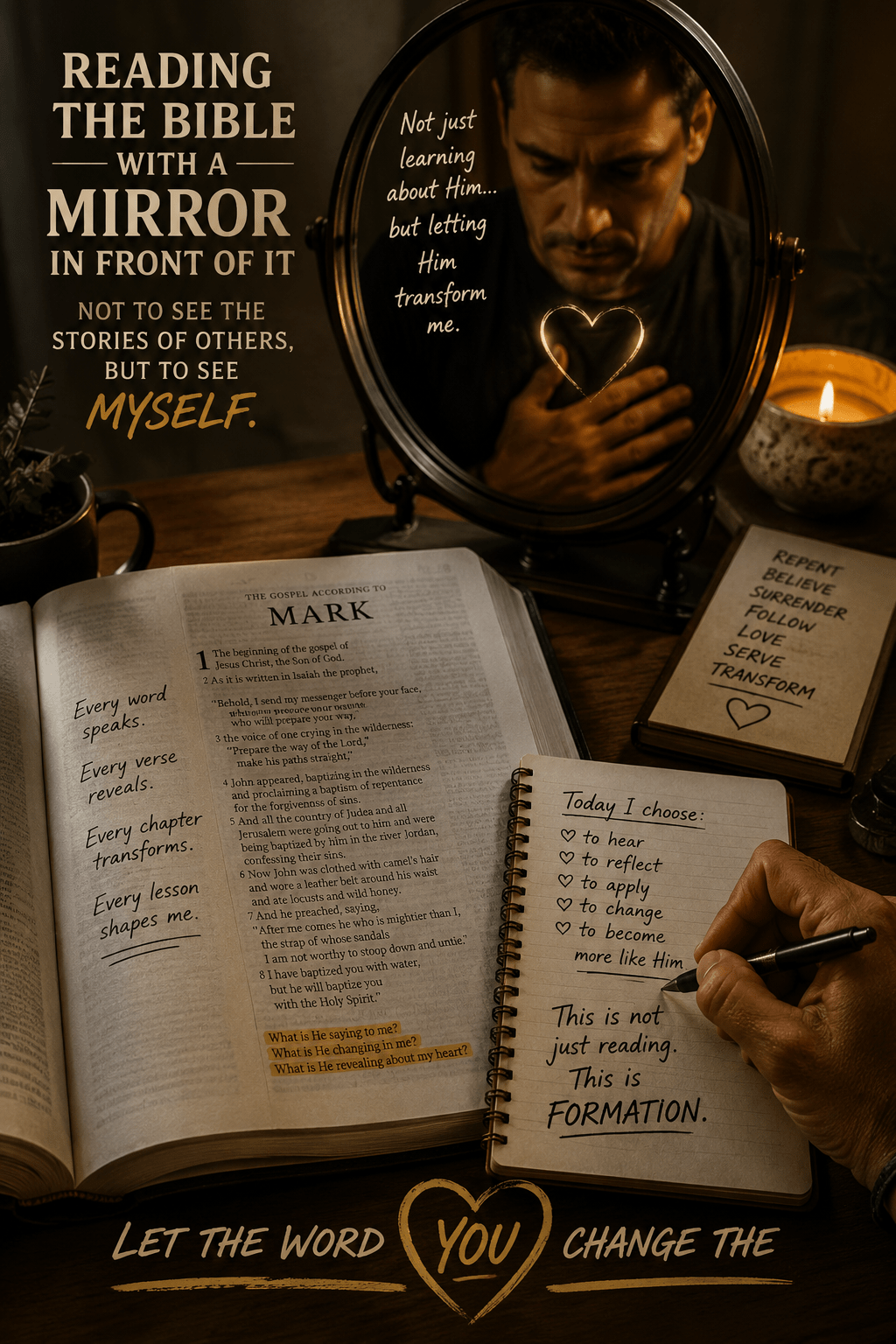
Mark opens his Gospel with action. There is no genealogy or birth narrative. Instead, he immediately introduces John the Baptist, the one preparing the way for Jesus. While the chapter is filled with miracles, teachings, and dramatic encounters, I believe the deeper message is about what must happen within every human heart before the Kingdom of God can truly be experienced.
This chapter is not simply the beginning of Jesus’ ministry. It is a roadmap for our own spiritual awakening.
Prepare the Way
John the Baptist arrives with a simple but profound message: Repent.
For years I understood repentance the way many people do, as feeling guilty, ashamed, or sorry for my sins. But after studying the original languages, I discovered that repentance carries a much deeper meaning.
The primary Hebrew word is shuv, which means to turn back, to return, or to change direction. The New Testament Greek word, metanoia, literally means a change of mind or a transformation in the way one thinks.
Repentance is not primarily about emotion. It is about reorientation.
It is the moment we recognize that the path we are walking is leading away from truth, and we intentionally turn back toward God. It is the decision to stop allowing the ego to determine the direction of our lives and instead surrender our will to something higher.
God rarely builds something new in a heart that refuses to let go of the old. Before transformation comes preparation. Before new life comes humility. Before Christ reigns within us, pride, self-deception, and the illusion of self-sufficiency must begin to give way.
Repentance is not the punishment before grace. It is the doorway into it.
Identity Before Purpose
Jesus is baptized, and before He performs a single miracle or teaches a single crowd, the Father speaks:
“You are my beloved Son; with you I am well pleased.”
I find this sequence incredibly significant.
Jesus receives His identity before He begins His mission.
So many of us reverse the order. We spend our lives trying to earn approval through accomplishment, success, ministry, wealth, influence, or recognition. We hope that if we achieve enough, we will finally believe we are enough.
God works in the opposite direction.
He establishes identity first.
Purpose flows from identity, not the other way around.
The healthiest people I know are not driven by a desperate need to prove themselves. They are driven by a quiet confidence in who they already are.
The Wilderness Is Not a Detour
Immediately after His baptism, the Spirit leads Jesus into the wilderness.
That has always fascinated me.
The Spirit does not lead Him around the wilderness. The Spirit leads Him into it.
One of the greatest surprises of spiritual growth is discovering that awakening is often followed by testing. We assume that when we begin walking with God, life should become easier. Instead, many of us discover seasons of loneliness, uncertainty, suffering, and silence.
Perhaps the wilderness is not evidence that God has abandoned us.
Perhaps it is evidence that He is preparing us.
The wilderness strips away distractions. It exposes the idols we didn’t know we had. It reveals what truly rules our hearts.
Mystically, the temptations of Jesus represent the competing voices every person must eventually confront.
The voice of comfort whispers, “Avoid suffering. Take the easy path.”
The spirit reminds us that growth rarely happens inside our comfort zones.
The voice of power says, “Control people and circumstances.”
The spirit teaches surrender instead of domination, trust instead of control.
The voice of pride insists, “Prove your worth.”
God reminds us that we are already His beloved.
The voice of self-will declares, “Live on your own terms.”
The spirit invites us to discover that true freedom is found in surrender, not independence.
Viewed this way, Satan represents anything that attempts to separate us from God’s will: fear, pride, resentment, selfish ambition, greed, and the illusion that lasting fulfillment can be found apart from God.
Notice the pattern in Mark’s Gospel:
Identity.
Testing.
Victory.
Mission.
This is often the pattern of every authentic spiritual journey.
We discover who we are. That identity is tested. We learn faithfulness in the wilderness. Then we are ready for the work God has prepared for us.
The wilderness is where the false self begins to die and the true self begins to emerge.
The Kingdom Begins Within
Jesus begins preaching:
“The Kingdom of God is at hand. Repent and believe the good news.”
Many people think of God’s Kingdom only as a future destination.
Jesus spoke of it as a present reality.
The Kingdom begins wherever God’s will is welcomed into the human heart.
Every day we choose which kingdom we will live under.
The kingdom of the ego is built upon fear, comparison, pride, and self-preservation.
The Kingdom of God is built upon love, truth, humility, forgiveness, and surrender.
The greatest battle is not taking place somewhere “out there.”
It is taking place within us.
Leave What Is Familiar
When Jesus calls Peter, Andrew, James, and John, they leave their nets immediately.
Following Jesus always requires leaving something behind.
Sometimes it is a habit.
Sometimes it is an identity.
Sometimes it is a relationship.
Sometimes it is simply an old way of thinking.
Growth requires release.
We cannot cling to yesterday while stepping into tomorrow.
Every calling requires surrender.
Truth Has Authority
Jesus teaches with authority, and the unclean spirits immediately recognize Him.
Truth has a unique quality.
It exposes whatever is false.
When divine truth enters our lives, our excuses begin to lose their power. Our fears become visible. Our unhealthy patterns are revealed. The false narratives we’ve believed about ourselves begin to crumble.
Light does not fight darkness.
It simply shines.
Healing Is Restoration
Jesus heals Peter’s mother-in-law and many others.
These miracles reveal more than Christ’s ability to heal physical disease.
God restores the whole person.
He heals our capacity to love.
He restores our ability to serve.
He renews broken relationships.
He gives purpose where there was once despair.
Healing is not merely the removal of pain.
It is the restoration of wholeness.
Solitude Fuels Purpose
Before dawn, Jesus withdraws to pray.
This detail is easy to overlook.
Yet it may be one of the most important lessons in the chapter.
Jesus continually stepped away from the demands of people so He could remain connected to the Father.
Solitude is not an escape from purpose.
It is the source of purpose.
We cannot continually pour into others without allowing ourselves to be filled.
Silence is not empty.
It is often where God speaks the loudest.
Compassion Crosses Every Boundary
The chapter concludes with Jesus touching a man with leprosy.
Everyone else avoided him.
Jesus moved toward him.
That may be one of the greatest pictures of God’s heart in all of Scripture.
God moves toward the parts of ourselves we try hardest to hide.
Our shame.
Our failures.
Our wounds.
Our fears.
His love is not intimidated by our brokenness.
His touch restores not only our relationship with Him but also our ability to reconnect with others and with our true selves.
Reflection
Mark 1 reveals that the Kingdom of God does not begin with miracles, success, or religious performance.
It begins with repentance, a willingness to change direction.
It is strengthened through testing.
It grows through surrender.
It is sustained through communion with God.
It expresses itself through compassion.
Ultimately, the Kingdom is not simply a place we hope to enter one day.
It is a reality that begins the moment God is allowed to reign within us.



Leave a Reply