I’ve spent a lot of time reading the Bible.
I’ve studied the stories. I’ve learned the names. I’ve memorized verses. I’ve listened to sermons explaining what happened thousands of years ago.
But somewhere along the way, I began asking a different question:
What if the Bible isn’t asking me only to understand what happened to them? What if it’s asking me to see what is happening in me?
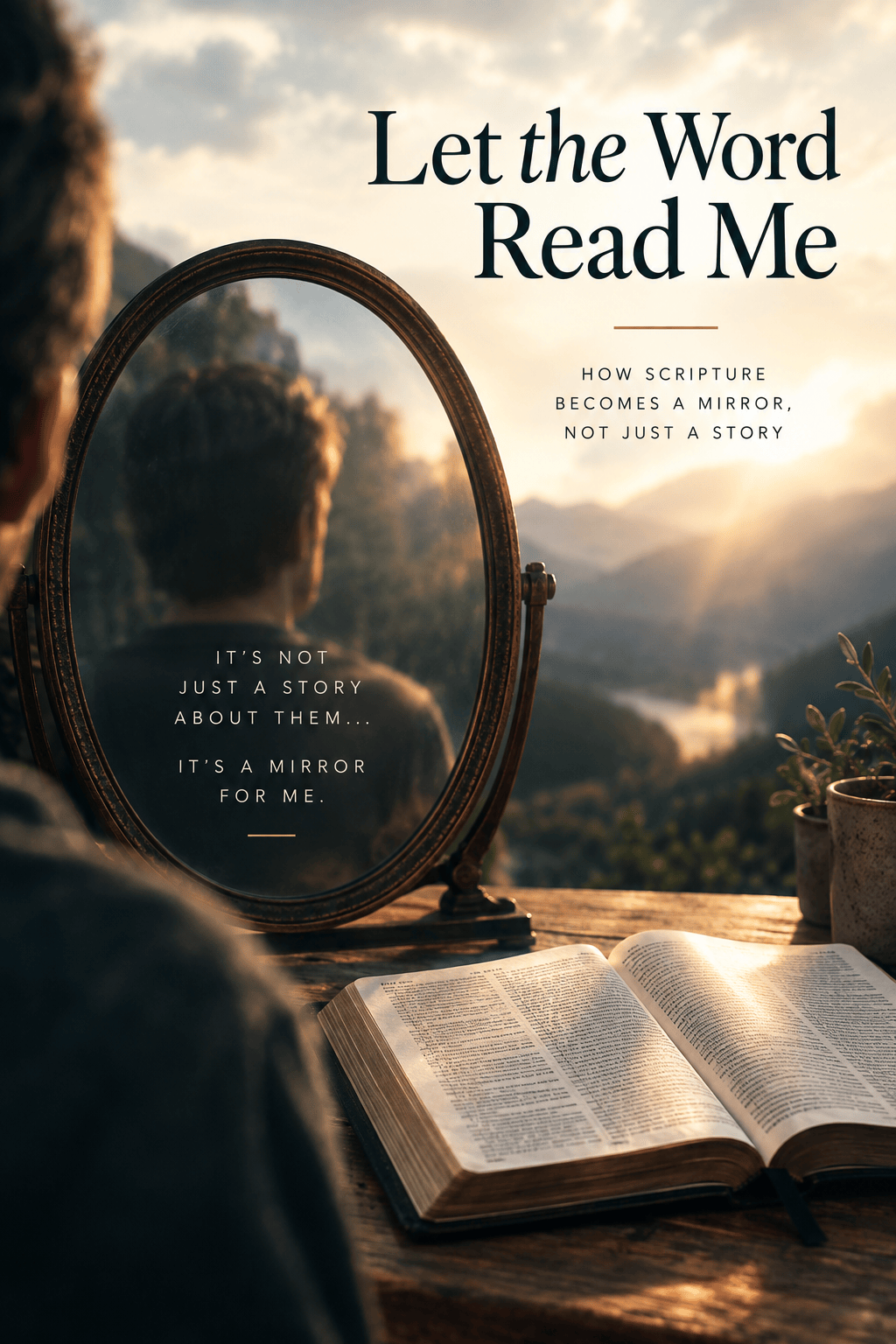
That’s when I started putting a mirror in front of Scripture.
I don’t want to read the Bible as though I’m standing outside of the story, watching other people make good decisions and bad decisions while I remain safely in the audience.
I want to step into the story.
I want to see myself in the Pharisee.
In Peter.
In Thomas.
In the prodigal son.
In the older brother.
In the person who is afraid.
In the person who judges.
In the person who runs.
In the person who finally surrenders.
Because if Scripture only tells me what happened to someone else, I can walk away informed without ever being transformed.
But when I put the mirror in front of it, the question changes.
Where am I in this story?
And perhaps even more importantly:
What is this story revealing about me?
The Word Becomes Flesh
John begins his Gospel with words that are almost impossible to comprehend:
“In the beginning was the Word.”
Before John tells me about miracles, disciples, arguments, healings, suffering, death, or resurrection, he takes me back to the beginning.
The Word.
Life.
Light.
And darkness.
John tells us that the light shines in the darkness and that the darkness does not overcome it.
I can read that as theology.
Or I can put the mirror in front of it.
Where is the darkness in me?
What have I refused to see?
What am I hiding from myself?
Where have fear, resentment, pride, anger, insecurity, or judgment taken up residence?
Maybe darkness isn’t simply something outside of me that I need God to remove.
Maybe sometimes darkness is the place where God is showing me what I need to see.
The light doesn’t have to condemn the darkness.
It simply has to expose it.
And when something is exposed, I finally have a choice.
I can defend it.
I can deny it.
Or I can surrender it.
I Don’t Have to Be the Light
John the Baptist enters the story as a witness to the light.
And he makes something very clear:
He isn’t the light.
He points toward it.
That makes me look at my own life.
How often do I want to be seen rather than point toward something greater than myself?
How often do I want credit for what I’ve learned?
How often does my ego turn even spirituality into another way of proving myself?
John’s humility challenges me.
Maybe I don’t have to be the light.
Maybe I simply need to stop standing in front of it.
I don’t have to be the answer.
I don’t have to convince everyone.
I don’t have to win every argument.
I don’t have to be right.
I can simply point toward what is true and allow people to encounter it for themselves.
What If I’m the One Who Doesn’t Recognize the Light?
John says the Word came into the world, yet the world did not recognize Him.
That bothers me.
Because it’s easy to read that sentence and think about them.
They didn’t recognize Him.
They rejected Him.
They didn’t understand.
But the mirror asks a harder question:
How often have I failed to recognize truth when it appeared in front of me?
How many times have I asked God to show me the way while secretly demanding that the answer agree with what I’ve already decided?
How often have I prayed for change while resisting anything that requires me to change?
Maybe my greatest problem isn’t that I don’t know enough.
Maybe sometimes I know exactly what I need to know.
I just don’t want to know it.
There is a difference between seeking truth and seeking confirmation.
The first requires humility.
The second requires nothing from me.
The Word Became Flesh
Then John gives me one of the most profound statements in Scripture:
The Word became flesh.
The Word didn’t remain an idea.
It became a life.
This is where Scripture becomes personal for me.
What good is knowing the Word if the Word never becomes flesh in my life?
I can know forgiveness and still refuse to forgive.
I can know humility and still need to be right.
I can know love and still judge the person who irritates me.
I can know grace and still condemn someone else.
I can talk about surrender while desperately trying to control everything around me.
I can study Jesus for the rest of my life without ever becoming more like what Jesus taught.
At some point, the Word has to become flesh.
Not just on the pages of a Bible.
In me.
The Word becomes flesh when knowledge becomes behavior.
When forgiveness becomes action.
When compassion replaces judgment.
When surrender replaces control.
When love becomes something I practice instead of something I talk about.
That is when Scripture comes alive.
“Who Are You?”
John is questioned about who he is.
And I find myself asking the same question.
Who am I?
Not my job.
Not my possessions.
Not my accomplishments.
Not my failures.
Not my reputation.
Not the mistakes I’ve made.
Not even the roles I play for other people.
Who am I beneath all of that?
John seems remarkably comfortable knowing what he is not.
He isn’t the Messiah.
He isn’t Elijah.
He isn’t the answer everyone is looking for.
He is a voice.
A witness.
Someone preparing the way.
There is freedom in that.
Maybe I don’t need to become important.
Maybe I need to become useful.
Maybe I don’t need everyone to know my name.
Maybe I need to make the path a little clearer for someone else.
What Needs to Be Straightened in Me?
John describes himself as the voice crying out to make straight the way.
I put the mirror in front of that statement and ask:
What needs to be straightened in me?
My priorities?
My relationships?
My habits?
My judgments?
My resentment?
My need for approval?
My desire to control?
My unwillingness to forgive?
My tendency to blame?
My attachment to an old version of myself?
Perhaps preparing the way for God isn’t always about preparing the world around me.
Perhaps sometimes it means preparing me.
Clearing the road.
Removing the obstacles.
Making room.
Becoming quiet.
Becoming honest.
Becoming willing.
“Come and See”
Then something beautiful happens.
People begin encountering Jesus.
And instead of giving everyone a complicated argument, the invitation is remarkably simple:
Come and see.
I love that.
Because transformation can’t always be explained.
Sometimes it has to be experienced.
You can tell me what forgiveness feels like.
Or I can forgive someone.
You can explain surrender.
Or I can finally release something I’ve been trying to control.
You can teach me about love.
Or I can choose to love someone who has given me every reason to withhold it.
There comes a point where spiritual understanding must become spiritual experience.
Come and see.
Try it.
Live it.
Step into it.
See what happens.
Nathanael and My Judgments
When Philip tells Nathanael about Jesus, Nathanael responds with skepticism.
His reaction is essentially:
Can anything good come from there?
I understand Nathanael.
I’ve done the same thing.
I’ve judged people before knowing them.
I’ve judged ideas because they didn’t fit my existing beliefs.
I’ve dismissed possibilities because they didn’t look the way I expected them to look.
I’ve decided what something was before I ever experienced it.
And again, the answer isn’t an argument.
It’s:
Come and see.
What if spiritual maturity isn’t having an answer for everything?
What if sometimes it means becoming humble enough to investigate what I previously dismissed?
Not blindly accepting.
Not blindly rejecting.
Come and see.
The Bible Is Supposed to Change Me
This is how I want to read Scripture now.
Not merely as history.
Not merely as theology.
Not merely as a collection of moral lessons about people who lived thousands of years ago.
I want to read it with a mirror in front of me.
When I read about someone’s anger, I want to examine mine.
When I read about someone’s pride, I want to examine mine.
When I read about someone’s forgiveness, I want to ask where I need to forgive.
When I read about someone’s fear, I want to recognize my own.
When I read about someone’s surrender, I want to ask what I’m still holding onto.
When I read about someone who cannot see, I want to ask:
Where am I blind?
When I read about someone who finally sees, I want to ask:
What am I beginning to see?
And when I read about resurrection, I don’t want to think only about what happened to Jesus.
I want to ask:
What needs to die in me so something new can live?
That is what I mean when I say I want to put a mirror in front of Scripture.
I’m not trying to change what the Bible says.
I’m allowing what the Bible says to change me.
Let the Word Read Me
Maybe I’ve been approaching Scripture backward.
I thought I was supposed to read the Bible to understand God.
Perhaps part of the journey is allowing the Bible to reveal me.
The Word becomes a mirror.
It shows me my attachments.
My fears.
My judgments.
My ego.
My wounds.
My resistance.
My love.
My potential.
And then it invites me forward.
Not toward perfection.
Toward transformation.
I don’t want to finish reading Scripture and say:
“Now I know more.”
I want to be able to say:
“Now I see more clearly.”
Not just more clearly about God.
More clearly about myself.
Because perhaps the purpose of bringing the Word to life isn’t simply to put more Scripture into my head.
Perhaps it is to allow the truth to move from my head into my heart, from my heart into my actions, and from my actions into the person I am becoming.
The old me wants to read the Word.
The new me wants to live it.
The old me wants to interpret the story.
The new me wants to find myself inside it.
The old me asks:
“What does this mean?”
The new me asks:
“What does this mean for me, right now?”
And maybe the deepest question isn’t:
“What does Scripture say?”
Maybe it is:
“What is Scripture saying to me?”
Because when I put the mirror in front of the Word, something changes.
I stop standing outside the story.
I enter it.
And that’s when the Word begins to become flesh.
Let the Word Read Me



Leave a Reply