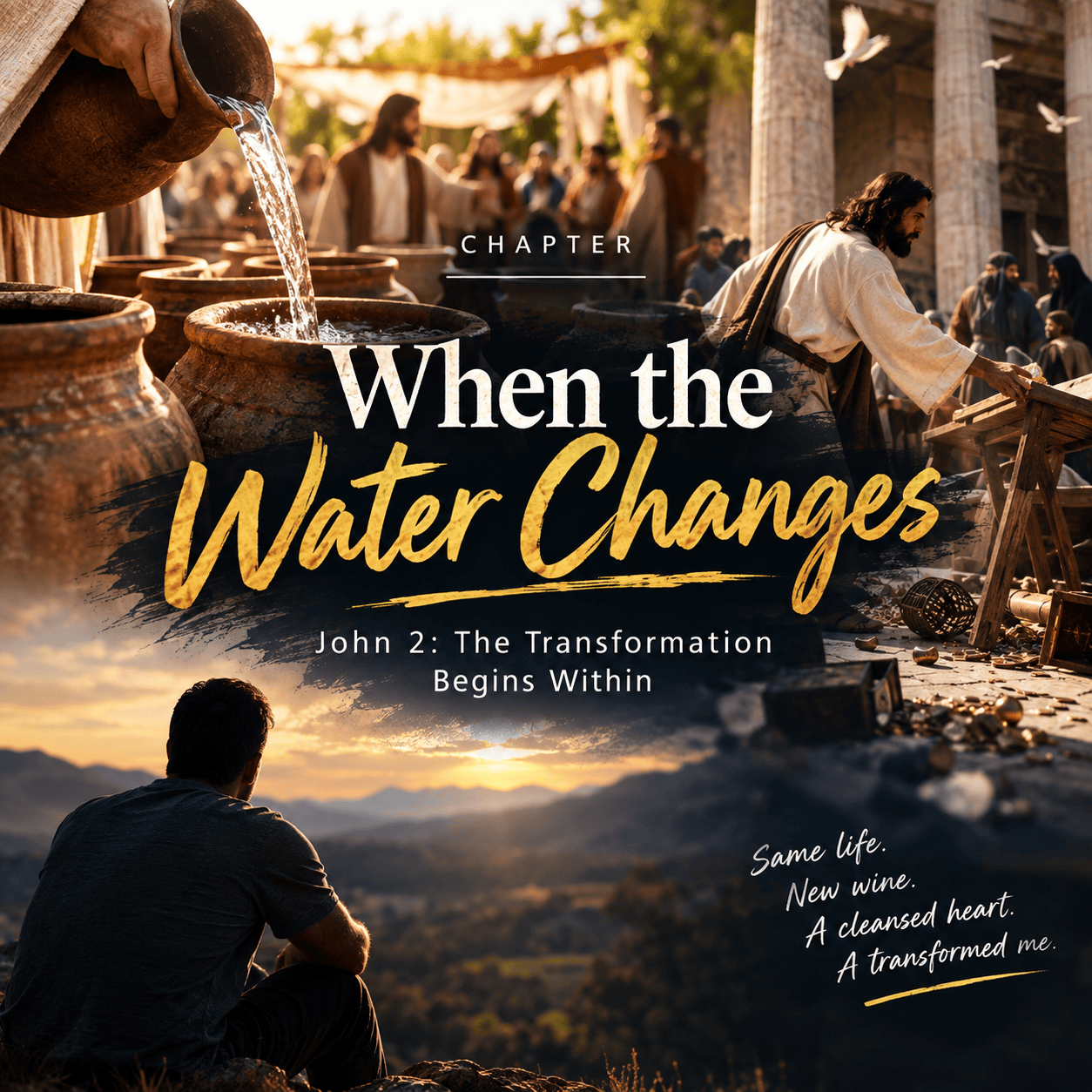
When the Water Changes
John 2: The Transformation Begins Within
John chapter 2 gives us two very different scenes.
In the first, Jesus is at a wedding in Cana, and something ordinary is transformed into something extraordinary. Water becomes wine.
In the second, Jesus walks into the Temple and drives out what does not belong there.
At first, these may seem like two unrelated stories. One is a miracle. The other is confrontation.
But when I put John 2 in front of me as a mirror, I see something much deeper.
Transformation requires both surrender and removal.
Something in me must be allowed to change, and something in me must be allowed to leave.
What Do I Have That God Can Transform?
At the wedding, Jesus doesn’t begin with something spectacular.
He begins with water.
Ordinary water.
The servants simply fill the jars.
Then something happens that they could not produce themselves.
The water becomes wine.
I think there is a lesson here for those of us who spend our lives waiting to become someone better before we believe God can use us.
Maybe I don’t need to become someone else.
Maybe I need to surrender who I already am.
My experiences.
My failures.
My regrets.
My strengths.
My weaknesses.
My relationships.
My work.
My body.
My mind.
My past.
Even the things I wish had never happened.
God can take ordinary things and transform them.
That means my past doesn’t have to be wasted.
My mistakes don’t have to be wasted.
My struggles don’t have to be wasted.
Even the places where I have fallen short can become places where I learn humility, compassion, discipline, and grace.
The question isn’t simply, “What do I need to become?”
Perhaps the better question is:
“What am I willing to place in God’s hands?”
“Do Whatever He Tells You”
Mary tells the servants something remarkably simple:
Do whatever he tells you.
There is something profound about that sentence.
She doesn’t tell them to understand everything.
She doesn’t tell them to figure out how the miracle will happen.
She doesn’t give them a five-year plan.
She tells them to listen and act.
That hits me personally because knowing and doing are two very different things.
I can know what Jesus teaches about forgiveness and still hold onto resentment.
I can know that love is more important than being right and still argue.
I can know that discipline matters and still choose comfort.
I can know that my body deserves care and still neglect it.
I can know that I need to surrender control and still try to control everything around me.
I can study Scripture for years and still fail to live the Scripture I already understand.
Maybe that’s one of the greatest obstacles to transformation.
We keep looking for new knowledge when God is waiting for us to act on what we already know.
So perhaps one of my prayers should be:
“God, show me what I already know but am not doing.”
That question can become uncomfortable very quickly.
But discomfort isn’t always a sign that something is wrong.
Sometimes discomfort is the beginning of transformation.
What Needs to Be Cleared Out?
Then Jesus enters the Temple.
And He sees something that doesn’t belong there.
The Temple was supposed to be a place of worship, but it had become occupied by things that had distorted its purpose.
Jesus cleanses it.
Now I have to turn the story toward myself.
If my life is a temple, what have I allowed inside?
What has taken something sacred and turned it into something else?
Maybe it’s resentment.
Maybe it’s pride.
Maybe it’s fear.
Maybe it’s my need for approval.
Maybe it’s the constant desire to be right.
Maybe it’s anger.
Maybe it’s an old addiction to comfort.
Maybe it’s self-pity.
Maybe it’s the story I keep telling myself about what happened to me.
Maybe it’s the belief that I am the victim of my circumstances rather than the person responsible for how I respond to them.
And maybe some things don’t need to be managed.
Maybe they need to be removed.
That’s a difficult thought.
We often want God to add something to our lives.
More peace.
More wisdom.
More faith.
More love.
More discipline.
But sometimes transformation begins by asking:
What needs to go?
The Temple Within
Jesus eventually points beyond the physical Temple toward His own body.
And that makes me think about something I’ve been learning throughout my own journey.
I can spend my entire life looking for God somewhere outside myself while ignoring what is happening within me.
I can attend church.
Read Scripture.
Study theology.
Listen to sermons.
Talk about Jesus.
And still avoid the Temple that needs the most attention:
me.
The question isn’t simply whether I believe in Jesus.
The deeper question is whether the way of Jesus is changing me.
Am I becoming more forgiving?
More honest?
More compassionate?
More disciplined?
More patient?
Less reactive?
Less judgmental?
More willing to surrender?
More willing to love people who don’t think like me?
Because if my relationship with God never reaches the way I treat people, then something is missing.
The transformation has not yet made its way from my beliefs into my life.
God Already Knows What’s Inside
John ends this chapter by saying that Jesus knew what was in people.
That reminds me that I don’t have to pretend with God.
I don’t have to present the polished version of myself.
God already knows what’s inside.
The anger.
The fear.
The insecurity.
The ego.
The good intentions.
The failures.
The potential.
The parts of me I’m proud of.
And the parts I would rather hide.
Perhaps surrender begins when I finally become honest enough to say:
“God, show me who I really am.”
Not who I want people to think I am.
Not who I think I should be.
Not who I was ten years ago.
Not who I hope to become someday.
Who am I right now?
And then:
“Show me what needs to change.”
That is a dangerous prayer.
But it may also be one of the most transformative prayers we can pray.
When the Water Changes
John 2 doesn’t just tell me that Jesus performed a miracle.
It invites me to become part of one.
The water represents what is ordinary.
The wine represents what is transformed.
The Temple represents the inner life that needs cleansing.
And Jesus stands in the middle of both stories, calling me beyond simply believing into becoming.
Maybe the miracle I am waiting for isn’t always something happening around me.
Maybe sometimes the miracle is what happens within me.
The person who used to react learns to pause.
The person who used to judge learns to understand.
The person who used to blame learns responsibility.
The person who used to hold resentment learns forgiveness.
The person who lived on autopilot begins to live consciously.
The person who was constantly searching outside himself begins discovering God within.
The water changes.
The Temple is cleansed.
And the person begins to become new.
So perhaps the question I need to carry with me isn’t:
“What miracle will God perform for me?”
Maybe it is:
“What in me am I willing to surrender so that God can transform it?”
And perhaps tomorrow morning, before I ask God to change my circumstances, I should ask Him to change me.
“God, show me the water in my life.”
“Show me what needs to be poured out.”
“Show me what needs to be removed.”
“Show me what I already know but am not doing.”
“And give me the courage to do whatever You tell me.”
Because transformation doesn’t always begin with something spectacular.
Sometimes it begins with something as ordinary as water.
And a person willing to surrender it.
When The Water Changes – John 2



Leave a Reply